




- 10 days9 nights
- Privateyour own Egyptologist
- 4-night cruiseLuxor to Aswan
- From $9,990per person
A luxury private Egypt tour with Nile cruise and Abu Simbel
Stand beneath the Great Pyramid, meet Tutankhamun’s golden mask and sail the Nile in five-star comfort, all with your own Egyptologist and nobody else’s schedule. This ten-day luxury private Egypt tour is for travellers who want to see the great sites properly, not from the back of a crowd.
You begin with four nights at the Four Seasons in Cairo: the Pyramids of Giza, the Grand Egyptian Museum, Saqqara and Dahshur, and the medieval lanes of Islamic and Coptic Cairo. Then you fly to Luxor and board an Oberoi Nile cruise for four nights to Aswan, visiting Karnak, the Valley of the Kings, Edfu, Kom Ombo and Philae. The journey ends at Abu Simbel and a final night at Aswan’s legendary Old Cataract hotel.
Everything is private, and every day can be tailored to your pace.
Journey highlights
- The Pyramids of Giza and the Great Sphinx, with time inside a pyramid
- The Grand Egyptian Museum and the complete treasure of Tutankhamun
- Saqqara and Dahshur, where the first pyramids were built
- Coptic and Islamic Cairo, the Citadel and Khan el-Khalili
- Four nights on the Nile aboard the Oberoi Zahra or Oberoi Philae
- The Valley of the Kings, including the tomb of Tutankhamun
- Karnak, Edfu, Kom Ombo and Philae along the river
- Abu Simbel, the colossal temples of Ramesses II
- A night at the Old Cataract, Aswan’s historic palace hotel
Your journey at a glance
- Day 1 Cairo · VIP arrival
- Day 2 Giza · The Pyramids and the Grand Egyptian Museum
- Day 3 Saqqara, Memphis and Dahshur
- Day 4 Coptic and Islamic Cairo, Khan el-Khalili
- Day 5 Luxor · Fly south, Karnak, board your cruise
- Day 6 Luxor West Bank · Valley of the Kings and Hatshepsut
- Day 7 Edfu and Kom Ombo · Temples along the river
- Day 8 Aswan · Philae, the High Dam and a felucca sail
- Day 9 Abu Simbel · Night at the Old Cataract
- Day 10 Fly home
What’s included
Included
- Private Egyptologist guide for all sightseeing
- VIP meet-and-assist at every airport and Egypt entry visa
- Private air-conditioned vehicle and driver throughout
- 4 nights in Cairo, 4 nights on the Nile cruise and 1 night in Aswan
- Domestic flights Cairo–Luxor and Aswan–Cairo
- Private round trip to Abu Simbel
- Entrance fees for the listed sites, including the Grand Egyptian Museum and Tutankhamun’s tomb
- Felucca sail in Aswan and boat to Philae Temple
- Meals as listed in the day-by-day plan; all meals on the cruise
- Bottled water every day and 24/7 support from our team in Egypt
Not included
- International flights
- Travel insurance
- Optional activities such as the Luxor balloon flight
- Gratuities for guides, drivers and crew
- Drinks, shopping and personal expenses
Your hotels and price
Hand-picked for location, service and a sense of history.
Luxury Elite
$9,990 per person
- Four Seasons Nile Plaza, Cairo · 4 nights
- Oberoi Zahra or Oberoi Philae Nile cruise · 4 nights
- Sofitel Legend Old Cataract, Aswan · 1 night
Prices per person, sharing a double room, for private touring. Final price depends on your dates and room category.
Where you’ll stay
Four Seasons Hotel Cairo at Nile Plaza
Our favourite hotel in Cairo stands on the Garden City Corniche, with some of the widest Nile views in the city. Expect faultless service, one of Cairo’s best spas, and excellent restaurants, so you never need to go far for a memorable dinner. It is central for every Cairo sight and a calm base after busy days.
The Oberoi Zahra or Oberoi Philae
The Oberoi Group’s two Nile ships were named the World’s Best River Cruise Line by Travel + Leisure in 2025 and 2026. With only a small number of suites each, they feel like floating boutique hotels: large suites with picture windows, a spa, a pool on the sun deck and refined dining. Fewer guests means calmer visits and more personal service. Compare both ships on our luxury Nile cruises page.
Sofitel Legend Old Cataract, Aswan
Opened in 1899 on a granite cliff above the Nile’s first cataract, the Old Cataract has welcomed Winston Churchill, Tsar Nicholas II and Agatha Christie, who wrote parts of Death on the Nile here. Its Moorish-style rooms, gardens and terrace over Elephantine Island make it one of the great historic hotels of Africa, and the perfect final night in Egypt.
The sites you’ll explore
The Pyramids of Giza and the Great Sphinx
The three pyramids of Giza were built for the kings Khufu, Khafre and Menkaure around 2600 to 2500 BC. The Great Pyramid of Khufu originally rose 146 metres and contains about 2.3 million stone blocks. It is the only one of the Seven Wonders of the Ancient World still standing. The Sphinx, carved from a single ridge of limestone, most likely portrays Khafre and guards the road to his pyramid.
The Grand Egyptian Museum
Opened in November 2025 just two kilometres from the Pyramids, the Grand Egyptian Museum is the largest museum in the world devoted to a single civilization, with more than 100,000 objects. For the first time, all of Tutankhamun’s treasures are displayed together, from his golden mask and thrones to his chariots and jewellery. Don’t miss the Grand Staircase of royal statues and the restored solar boat of Khufu.
Saqqara and the Step Pyramid of Djoser
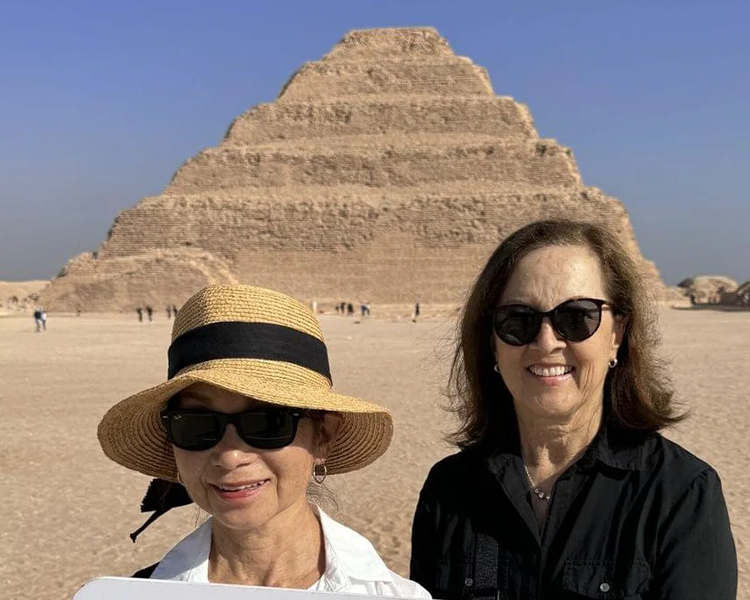
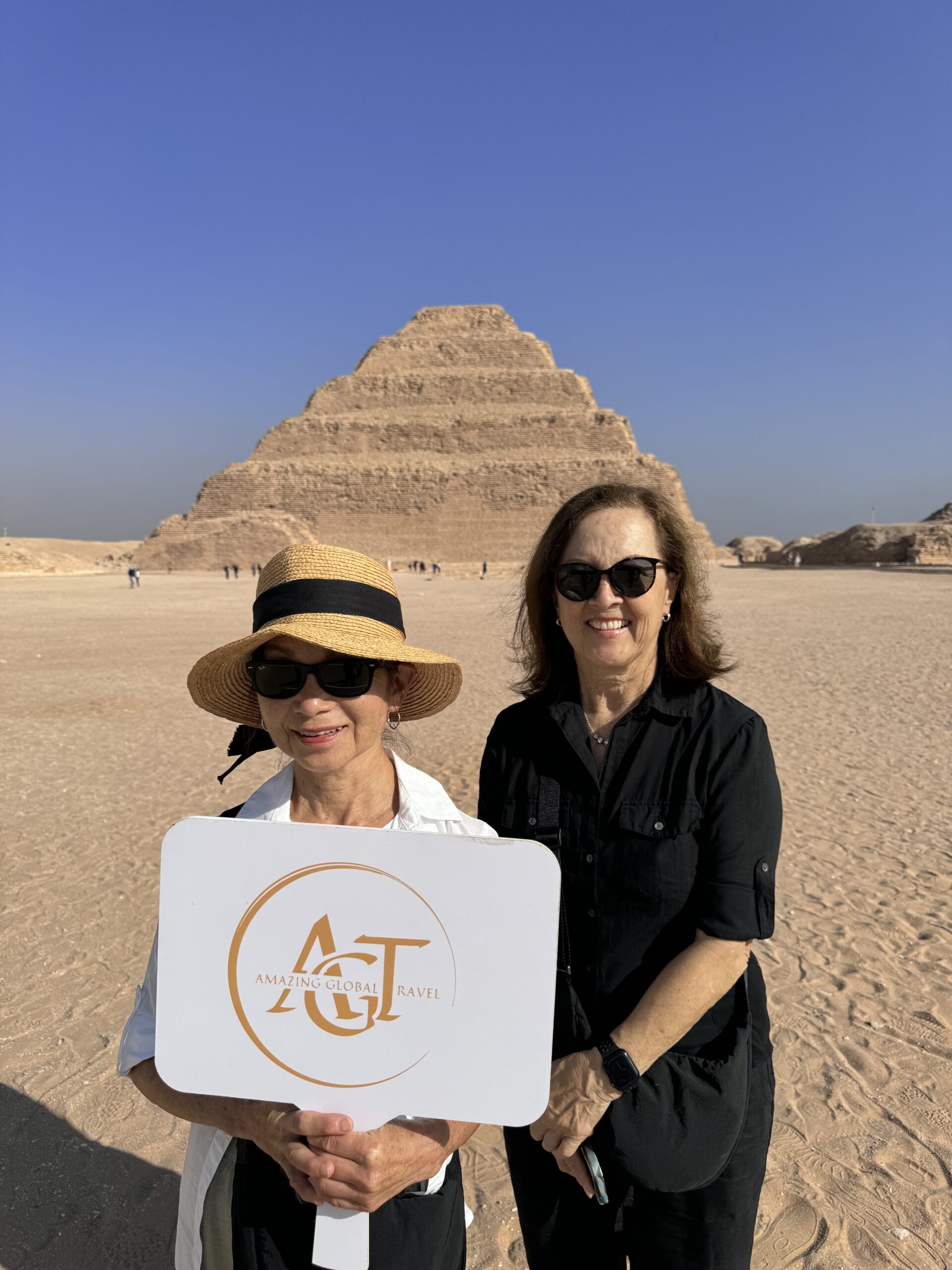
Saqqara was the burial ground of Memphis, Egypt’s first capital, for 3,000 years. The Step Pyramid of King Djoser, built around 2670 BC and designed by the architect Imhotep, is the oldest large stone building in the world. Nearby, the Pyramid of Unas holds the Pyramid Texts, the oldest religious writings of ancient Egypt. At Dahshur, King Sneferu’s Bent and Red pyramids show the experiments that led to Giza.
Karnak and Luxor Temple
Karnak, the home of the god Amun, grew over 2,000 years as pharaoh after pharaoh added to it, and it is the largest religious site ever built. Its Great Hypostyle Hall holds 134 giant columns, the tallest 21 metres high. Luxor Temple, linked to Karnak by the restored Avenue of Sphinxes, glows beautifully under its evening floodlights.
The Valley of the Kings and the Temple of Hatshepsut
For about 500 years, the pharaohs of the New Kingdom were buried in this hidden valley on Luxor’s West Bank. More than 60 tombs have been found, painted with the journey of the sun through the underworld. The most famous, KV62, belonged to Tutankhamun and was discovered almost intact by Howard Carter in 1922; his mummy still rests inside. Nearby rises the terraced temple of Hatshepsut, one of the few women to rule as pharaoh.
Edfu and Kom Ombo
The Temple of Horus at Edfu, built by the Ptolemies between 237 and 57 BC, is the best-preserved temple in Egypt. Kom Ombo is a perfectly symmetrical double temple, one half for Sobek the crocodile god and the other for Horus the falcon god, with a museum of mummified crocodiles next door.
Philae Temple
Philae, the island temple of Isis, was the last place in Egypt where the ancient gods were worshipped, until the sixth century AD. When the Aswan dams threatened to flood it, UNESCO moved the whole temple, stone by stone, to Agilkia Island between 1972 and 1980. You arrive by boat, just as pilgrims did 2,000 years ago.
Abu Simbel
Ramesses II carved these two temples into a sandstone cliff around 1264 BC. Four 20-metre seated statues of the king guard the main temple, and a smaller temple honours his queen, Nefertari. Twice a year, around 22 February and 22 October, the rising sun reaches deep inside to light the statues in the sanctuary. In the 1960s, as Lake Nasser rose, both temples were cut into more than 1,000 blocks and rebuilt 65 metres higher.
Good to know before you go
Best time to travel
October to April is the best time, with sunny days of about 20 to 28°C (68 to 82°F). December to February is the busiest season, so book six to nine months ahead for the Oberoi ships. In summer, Luxor and Aswan can pass 40°C (104°F), so we start sightseeing at dawn.
Visa and passport
Your Egypt entry visa is included and arranged by our representative at the airport. Your passport must be valid for at least six months after you arrive.
What to wear
Light, breathable clothes that cover shoulders and knees are comfortable and respectful at mosques and churches; women may want a scarf for mosques. Pack good walking shoes, a hat, sunglasses and sunscreen, and a light jacket for cool evenings from December to February.
How active is this tour?
Moderate. Expect two to four hours of walking most days, sometimes on sand and uneven stone. Entering a pyramid or tomb means stairs and narrow passages, and it is always optional. We can slow the pace or adapt visits for limited mobility.
Money and tipping
The currency is the Egyptian pound. Cards are accepted in hotels and most shops; carry small notes for markets and tips. As a guide, many travellers give their Egyptologist US$10 to 15 and their driver US$5 to 10 per person per day, and about US$10 per person per night for the cruise crew.
Make this journey yours
Add a sunrise balloon flight over Luxor, a few days on the Red Sea, Alexandria or Petra in Jordan. Our team in Egypt will tailor the journey to you.
Frequently asked questions
Is this tour private?
Yes. Only you and your travel companions share your Egyptologist, driver and vehicle. On the Nile cruise you share the ship with other guests, but your sightseeing can be private on request.
Can the itinerary be changed?
Yes. Dates, hotels, cruise and length of stay can all be tailored. Popular additions are a Luxor balloon flight, a Red Sea beach stay, Alexandria or Petra in Jordan.
How many days do I need in Egypt?
Ten days is ideal for a first visit: enough for Cairo, a four-night Nile cruise and Abu Simbel without rushing. For a shorter trip, see our 6-day luxury private tour.
Will I see Tutankhamun’s golden mask and tomb?
Yes. His golden mask and full treasure are at the Grand Egyptian Museum on Day 2, and his tomb in the Valley of the Kings is included on Day 6.
How do I get to Abu Simbel?
By private car from Aswan, about three and a half hours each way, or by a 45-minute flight, which we can add on request.
What is the best time of year for this tour?
October to April has the most comfortable weather. November, February and March combine pleasant temperatures with fewer crowds than the Christmas holidays.
Do I need a visa for Egypt?
Your tourist visa is included and arranged on arrival. Your passport must be valid for at least six months.
Is this tour suitable for children and older travellers?
Yes. Because it is private, we set the pace, add rest time and choose family rooms or step-free visits where needed.
How do I book and pay?
A deposit secures your booking and the balance is due before arrival. See our Payment & Cancellation Policy for full details, or contact us to reserve your dates.


